It is always exciting when a long-term effort pays off, and today I’m delighted to share our latest publication in the Annual Review of Microbiology, titled Biophysics of Microbial Locomotion.
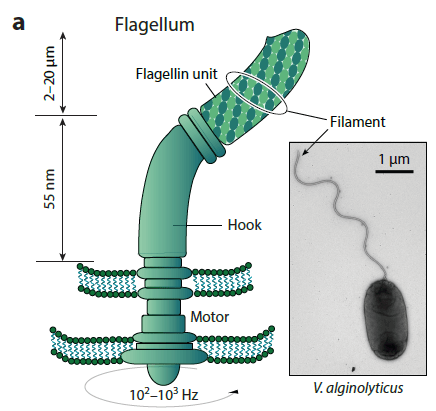
This was a real team effort with Tommaso Redaelli and Isobel Short, with the review delving into how the physics of the microscale, where viscosity rules and our everyday intuition about motion breaks down, shapes the ways microbes swim, glide and twitch, how they navigate complex environments, and what it costs them (and what they gain) from an evolutionary perspective. Importantly, we aimed to produce a review with more of a teaching perspective – we hope that this will be a useful resource for explaining what is normally a more physics-dominated topic to a broader scientific audience.
Like buses, news comes in groups, and I’m excited to share two further preprints that have come out in the last month. The first, led by Valerio Anelli, a PhD student in the StockerLab, explores the role of fucoidan in microbial interactions. Fucoidan is among the most abundant polysaccharides in brown macroalgae and is highly resistant to degradation, so we were surprised to find that all 14 marine bacterial strains we tested were attracted to fucoidan from two different macroalgal species when it was present at high concentrations, similar to those expected right next to an algal surface. Even though the bacteria can’t grow on fucoidan, it didn’t harm them or stop them from using other carbon sources, which suggests it acts as a chemical cue that guides bacteria towards the nutrient-rich surface of macroalgae and may shape both macroalgal microbiomes and carbon cycling in the ocean. You can read the preprint, titled Widespread attraction of marine bacteria to the macroalgae-derived polysaccharide fucoidan here.
Second, led by former postdoc of the StockerLab Mathieu Forget, titled“Bacterial capture and lysis on diatom spines reveal a suspension-feeding strategy”. We found that the long chitinous spines of the diatom Conticribra weissflogii act as attachment sites for the bacterium Marinobacter adhaerens, and that roughly a fifth to a third of the spine-attached bacteria show signs of lysis. Diatoms carrying bacteria on their spines also took up more bacteria-derived nitrogen, which suggests the spines work like the sticky pseudopods of radiolarians and foraminiferans, intercepting bacteria from the surrounding water and giving diatoms a previously overlooked route to mixotrophy. You can read the preprint in full here.
Lots of exciting news, and more to come in the following months!
Bonus image – Wallace the Whale, who sadly did not make it past the review process, but is here to say hi anyway!

