Delighted to share our most recent paper out today in Science Advances titled “Bacteria induce an amoeboid phase in coccolithophores that persists after bloom collapse”. This work was led by Sophie Zweifel, a PhD student in the Stocker Lab, and delves into a previously uncharacterised life-stage in bloom-forming coccolithophores.


Coccolithophores, such as Geophryocapsa huxleyi (formally Emiliania huxleyi), follow a biphasic lifestyle, switching from a heavily-calcified diploid morphotype, to a motile but less-calcified haploid form. This species is responsible for the kilometre-scale algal bloom events visible from space (and often seen in the media!), and one of the most important oceanic primary producers.
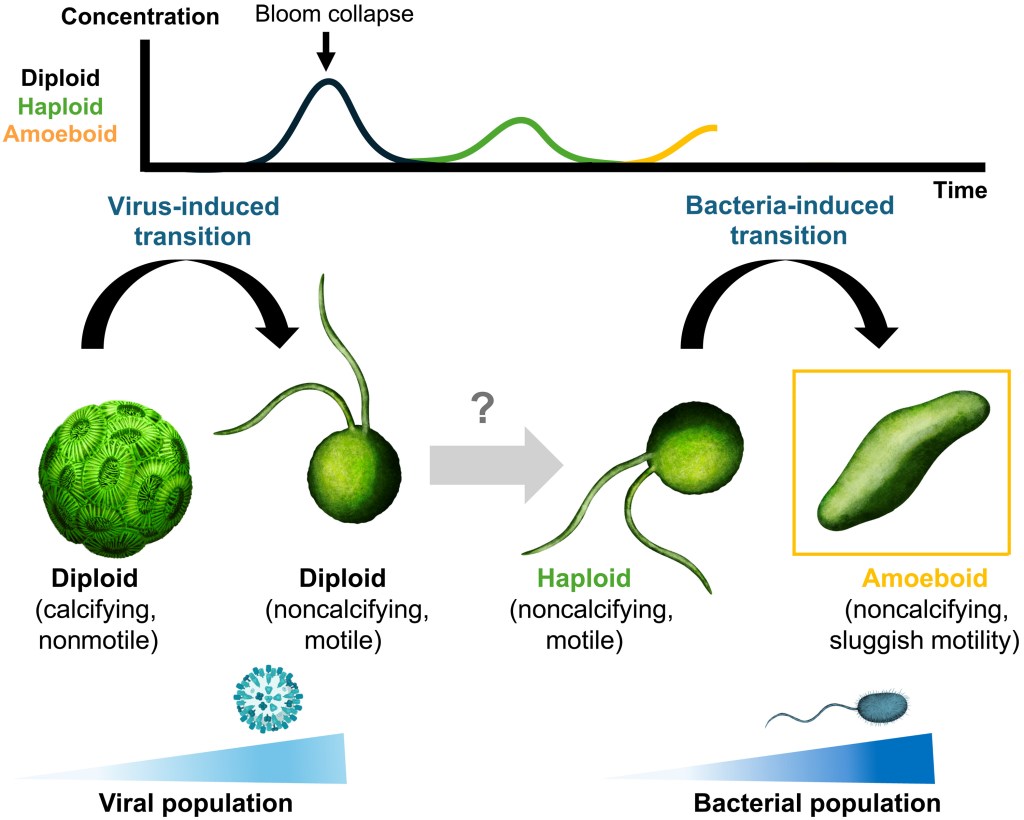
Source: Zweifel et al, Sci. Adv. 11, eadw 7280 (2025)
In this work, we characterised a rapid metamorphosis of the single cell, whereby a haploid cell rapidly elongates and drastically alters its swimming patterns. Through an extensive screening panel, we show that this transition is solely induced in bloom-forming coccolithophores when exposed to high bacterial concentrations, in conditions reminiscent of algal bloom collapse. These ‘amoeboid’ cells are capable of persisting long after the haploid phase has succumbed to the harsh environmental conditions generated by the surrounding bacterial population, and presents a potential avenue for the cells to survive and propogate after a bloom collapse. This is another exciting example of how inter-species interactions shape ecosystem-scale processes and events, and opens up new questions in our understanding of these key microbial players.
The volume of work in this paper is a true testament to the efforts of Sophie and her curiosity – what started as a “oh what’s that on the microscope” has defined a new life stage in one of the most important phytoplankton species. If you want to see more of her PhD work, we also recently posted a preprint of her next work on the role of the coccosphere in protecting from bacterial attack.
 Richard Henshaw