Delighted to announce my latest publication hit the presses today in Nature Microbiology! This is the publication of my primary work from my time at Tufts University with Jeffrey Guasto in collaboration with the labs of Sheri Floge at Wake Forest University (North Carolina) and Trent Northen at Berkeley Lab (California). A perspective/commentary piece is also featured in this month’s News and Views at Nature Microbiology!
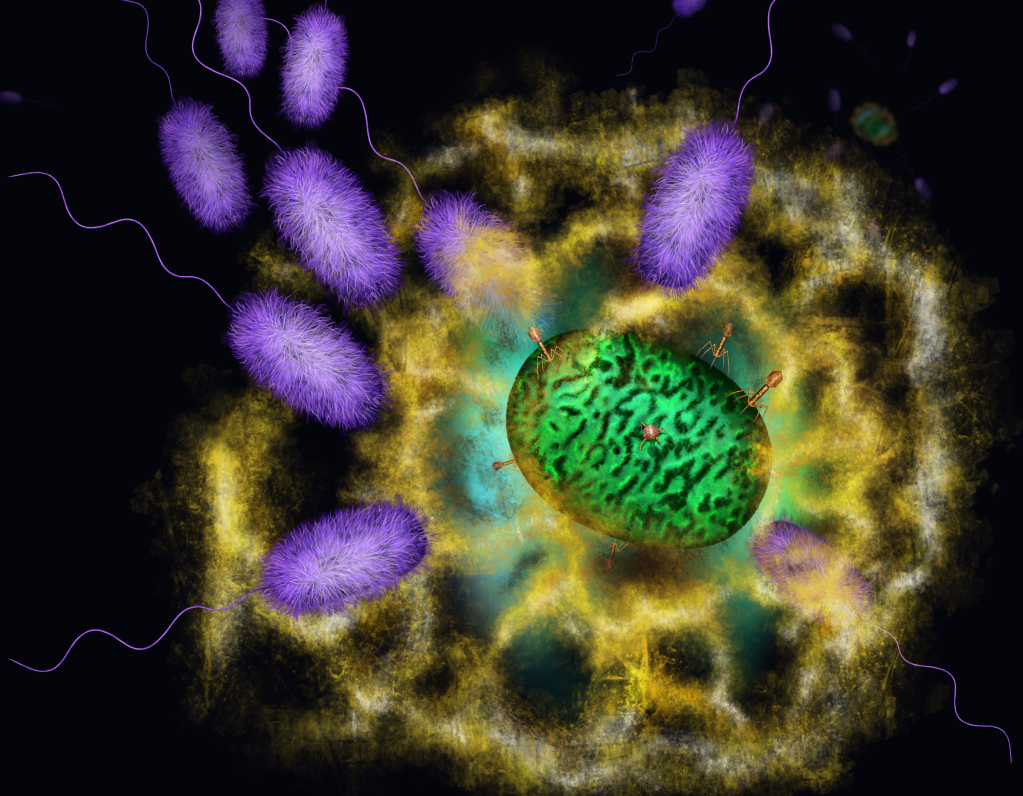
Image credit: Dr. Roberto Pioli
About a quarter of the global primary production is due to micrometre-sized algae such as Synechococcus. These “cyanobacteria” are prone to viral infection, during which the cells undergo internal metabolic changes before bursting open (“lysis”) and releasing a large patch of organic material. This acts as a food source for the surrounding bacterial communities in the otherwise sparse nutrient landscape of the oceans, swimming towards these patches in a process known as chemotaxis.
In our work, we showed that the early-stage infection dynamics, when the host is still intact, drives chemotaxis as strongly as the sudden release during lysis. This is important as it opens up a previously-neglected source of microbial interactions and nutrient flux, providing bacteria with a long-lasting source (on the scale of hours) compared to lysis which typically lasts a few minutes.
During the study, we used a combination of time-resolved metabolomics, microscopy, and microfluidics (including the MCD) to identify the virus-induced changes in the exudation from infected cyanobacteria, and how they impact the chemotaxis and foraging behaviour of heterotrophic bacteria. It was an incredibily interdisciplinary project and the culmination of over 5 years of collaborative effort to achieve this goal! It was a pleasure and priviledge to be part of such a diverse scientific effort – I’m extremely proud of the work we have achieved together and excited to see where it leads us next!
The full paper, titled “Metabolites from intact phage-infected Synechococcus chemotactically attract heterotrophic marine bacteria” is published now at Nature Microbiology.
 Richard Henshaw